


Supporting multiple overhead piping systems requires more than simply attaching individual hangers to the building structure. As commercial and industrial facilities become more complex, engineers and contractors often need support systems that organize multiple pipe runs while minimizing structural attachment points and simplifying installation. Trapeze pipe hangers provide an efficient solution by supporting several horizontal pipes from a single overhead assembly, making them a common choice for mechanical rooms, utility corridors, process piping systems, and other MEP applications. Their modular design allows multiple building systems to be supported within a coordinated framework while maintaining access for future maintenance and inspections. Proper design requires careful consideration of structural loading, attachment methods, support spacing, and coordination with surrounding mechanical systems. This guide explains how trapeze pipe hangers work, when they should be specified, and the engineering principles that help create safe, organized, and code-compliant pipe support systems.
What Is a Trapeze Pipe Hanger?

A trapeze pipe hanger is a structural support assembly designed to suspend multiple horizontal pipe runs from a single overhead support system. Rather than installing an individual hanger for each pipe, a trapeze assembly uses threaded rods to suspend a horizontal cross member that supports several pipes at once. The assembly typically consists of structural attachments connected to the building frame, threaded rods, a structural steel or modular strut cross member, and pipe clamps, pipe rollers, or other pipe support hardware. This configuration allows multiple piping systems to share one engineered support assembly while maintaining proper spacing between each service. Depending on the application, trapeze pipe hangers may support domestic water piping, hydronic systems, chilled water, compressed air, fire protection piping, or industrial process lines. The design is intended to create an organized overhead installation while reducing the total number of ceiling attachment points required throughout the project.
Unlike individual pipe hangers, trapeze pipe supports allow several utilities to be grouped within a common structural framework. Fewer attachment points can reduce installation time while creating a cleaner overhead layout that simplifies future maintenance activities. The cross member provides flexibility for positioning pipes at different elevations or horizontal offsets without requiring separate supports for every line. Modular framing systems also allow additional supports or accessories to be added as project requirements change. This adaptability makes trapeze assemblies well suited for both new construction and renovation work where piping layouts may evolve during installation. When properly engineered, trapeze pipe hangers provide an efficient method for supporting multiple piping systems while maintaining structural integrity and accessibility.
When Should Trapeze Pipe Hangers Be Used?

Trapeze pipe hangers are typically specified whenever several parallel piping systems follow a common route through a building. Mechanical rooms, central utility plants, manufacturing facilities, hospitals, laboratories, and data centers frequently contain multiple piping systems that must be installed within limited overhead space. Supporting each pipe individually can create unnecessary congestion above the ceiling while increasing the number of structural attachments required. A trapeze pipe support consolidates these systems into a single organized assembly that simplifies both installation and future maintenance. Engineers often specify trapeze supports when multiple building services share the same corridor or equipment room. The result is a more coordinated installation that allows trades to work within clearly defined spaces.
These support assemblies also improve coordination with other building systems installed above the ceiling. Mechanical ductwork, electrical conduit, cable tray systems, fire protection piping, and plumbing infrastructure must often coexist within the same structural bay. Trapeze assemblies help organize piping without interfering with adjacent systems or restricting maintenance access. They also simplify future expansion because additional piping can often be incorporated into an existing support framework if adequate capacity has been engineered into the original design. On projects where prefabrication is used, trapeze assemblies can be assembled off-site and delivered ready for installation, reducing field labor and improving installation consistency. Their versatility makes them a practical choice for many commercial and industrial construction projects.
What Should Be Included in a Trapeze Pipe Hanger Detail?

A trapeze pipe hanger detail provides the information necessary for engineers, fabricators, and installers to construct the support assembly as intended. Engineering drawings typically identify the structural attachment method, cross member type, threaded rod diameter, support elevations, pipe spacing, framing dimensions, and required connection hardware. Pipe sizes, insulation thickness, hanger locations, and support intervals are also commonly shown to ensure the completed installation matches the project design. These details help contractors understand how the support assembly interfaces with both the building structure and the piping systems it will carry. Clear documentation reduces the likelihood of field modifications that could affect structural performance or installation efficiency. Every trapeze detail should correspond with the project’s structural drawings and mechanical design documents.
Load requirements are another important component of a trapeze pipe hanger detail. Engineers must account for the combined weight of the pipe, conveyed fluid, insulation, valves, fittings, and other attached equipment when designing the support assembly. The drawings should also specify the framing members, threaded rods, and structural attachments required to support these calculated loads. Where thermal expansion, seismic requirements, or vibration isolation are applicable, those design considerations should also be incorporated into the support detail. Material specifications, corrosion protection requirements, and installation notes provide additional guidance for contractors during construction. A complete engineering detail helps ensure the installed support system performs as intended throughout the life of the facility.
How Are Trapeze Pipe Hangers Attached to the Structure?

Trapeze pipe hangers must be attached directly to structural building elements capable of supporting the intended design loads. The appropriate attachment method depends on the building’s structural system and may include beam clamps attached to structural steel, welded steel connections where permitted by the project specifications, concrete expansion anchors, adhesive anchors, cast-in-place inserts, threaded inserts, or deck inserts designed for the supporting structure. These structural connections transfer the supported pipe loads into the building framework through threaded rods that suspend the trapeze cross member below. Selecting the correct attachment method requires evaluating the supporting material, anticipated loading conditions, and manufacturer load ratings. Attachment hardware should never be selected solely based on installer preference or material availability. Every connection should follow the engineered drawings and the applicable installation instructions provided by the hardware manufacturer.
The structural attachment must also account for all anticipated loading conditions throughout the operating life of the piping system. Engineers evaluate dead loads created by the piping assembly itself along with the weight of conveyed fluids, insulation, valves, strainers, and other inline equipment. Thermal expansion, vibration, and seismic loading may also influence attachment design depending on the project location and building occupancy. Anchor capacities, allowable loads, edge distances, and structural member strength must all be verified before installation begins. Properly designed structural attachments help ensure that the trapeze assembly performs consistently without overstressing the building structure or the support hardware. Because every building presents different structural conditions, engineered attachment details remain one of the most important aspects of trapeze pipe hanger design.
How Much Weight Can a Trapeze Pipe Hanger Support?

There is no single weight rating that applies to every trapeze pipe hanger because each assembly is engineered for its specific application. The load capacity depends on several factors, including the size and material of the cross member, the diameter and grade of the threaded rods, the structural attachment method, the span between supports, and the capacity of the supporting structure. A trapeze designed to support a few small domestic water lines will have significantly different load requirements than one supporting large process piping or chilled water mains. The total supported load includes more than the weight of the pipe itself. Engineers must account for the weight of the conveyed fluid, insulation, valves, flanges, fittings, and any inline equipment attached to the piping system. These combined loads determine the structural requirements for the complete support assembly.
Additional loading conditions may also influence the final design of a trapeze pipe support. Thermal expansion and contraction can introduce forces that must be considered when selecting support locations and hardware. In seismic regions, building codes may require additional bracing or specialized support details to accommodate lateral movement during seismic events. Concentrated loads created by heavy valves, strainers, pumps, or other equipment often require supplemental supports beyond a standard trapeze assembly. For larger mechanical and industrial piping systems, engineers may specify structural steel framing or heavy-duty modular framing systems instead of standard strut channel to provide the required capacity. Every trapeze pipe hanger should be designed using manufacturer load data, engineered calculations, and the applicable building codes to ensure reliable long-term performance.
Is It Required to Center the Pipe in the Trapeze?

No. Pipes do not always need to be perfectly centered within a trapeze pipe hanger, provided the support system has been engineered to safely accommodate the applied loads. While symmetrical layouts often simplify design and installation, proper load distribution is far more important than placing every pipe directly in the center of the cross member. Engineers evaluate how each pipe contributes to the overall loading of the support assembly and position the piping accordingly. Smaller utility lines, larger process piping, and insulated systems may all occupy different locations along the trapeze based on available space and coordination with surrounding building systems. As long as the framing members, threaded rods, and structural attachments are designed for those loading conditions, offset pipe placement can be entirely appropriate. The engineered design should always determine pipe placement rather than appearance alone.
Eccentric loading occurs whenever supported loads are positioned away from the centerline of the support member. While eccentric loading is common in many commercial and industrial installations, it increases the importance of proper structural calculations because it can introduce additional bending moments and torsional forces into the framing system. Engineers account for these forces when selecting framing members, rod sizes, and attachment hardware. Pipe spacing must also provide adequate clearance for insulation, valves, maintenance access, and future system modifications. Installers should avoid repositioning pipes in the field solely to create a more symmetrical appearance if doing so differs from the engineered drawings. Manufacturer recommendations and project-specific engineering should always take precedence over generalized installation practices.
What Is the Proper Spacing for Pipe Supports and Hangers?

There is no universal spacing requirement for trapeze pipe hangers because support intervals depend on the characteristics of the piping system being installed. Pipe material, outside diameter, wall thickness, operating temperature, insulation weight, conveyed fluid, and anticipated loading conditions all influence allowable support spacing. Copper tubing, carbon steel pipe, stainless steel pipe, PVC, CPVC, and ductile iron piping each have different support requirements established by manufacturers and industry standards. As pipe sizes increase, the combined weight of the pipe and conveyed fluid often requires shorter support intervals or heavier support assemblies. Engineers determine support spacing using project specifications, applicable codes, and manufacturer recommendations. Trapeze assemblies must be located so each supported pipe remains within its allowable span.
Support spacing also requires coordination with the overall building layout and structural framing. Engineers often position trapeze assemblies to align with structural steel, concrete framing, or other suitable attachment points capable of supporting the calculated loads. Changes in pipe direction, branch connections, valves, expansion joints, and heavy inline equipment may require additional supports beyond the standard spacing interval. Thermal expansion can also affect support placement, particularly on long piping runs that experience significant temperature variation during operation. Proper spacing helps minimize pipe deflection while maintaining alignment and reducing unnecessary stress on joints and fittings. A well-designed support layout balances structural performance, installation efficiency, and long-term serviceability.
Trapeze Pipe Hanger Installation Best Practices

Successful trapeze pipe hanger installation begins with accurate layout and coordination before materials arrive on site. Installers should verify structural attachment locations, overhead clearances, pipe elevations, and potential conflicts with ductwork, cable trays, electrical conduit, and other building systems. Structural attachment hardware must be installed in accordance with the engineered drawings and manufacturer installation requirements before threaded rods and cross members are assembled. Maintaining level framing members is important to ensure proper pipe alignment and consistent load distribution across the support system. Pipe insulation thickness, valve locations, and maintenance access should also be verified before the final position of each support assembly is established. Careful planning during the layout phase helps reduce field modifications and installation delays.
Once the trapeze assembly is installed, crews should inspect the support system before piping is fully loaded. Threaded rods should be securely tightened, framing members properly aligned, and attachment hardware installed according to project specifications. Pipe clamps and supports should allow adequate clearance for insulation while accommodating any anticipated thermal movement specified by the engineer. Where prefabricated trapeze assemblies are used, installers should confirm that field conditions match the prefabricated dimensions before final installation. Coordination between mechanical, plumbing, electrical, and fire protection trades remains important throughout installation to avoid conflicts as overhead systems are completed. A systematic installation process improves consistency while helping ensure the completed support system performs as designed.
Common Trapeze Pipe Hanger Design Mistakes

Many installation problems originate during the design phase rather than during construction. One common mistake is selecting framing members or threaded rods that are undersized for the anticipated loading conditions. Designers must account for the weight of the pipe, conveyed fluid, insulation, valves, fittings, and any additional equipment carried by the support assembly. Another frequent issue is excessive spacing between trapeze supports, which can increase pipe deflection and place unnecessary stress on joints and fittings. Failing to coordinate support locations with structural framing can also create installation delays when suitable attachment points are unavailable. Thorough engineering and early coordination help prevent these issues before construction begins.
Field coordination errors can also reduce the effectiveness of an otherwise well-designed support system. Overlooking insulation thickness may create insufficient clearance between adjacent piping systems or interfere with nearby mechanical equipment. Improper structural attachments or incorrectly installed anchors can reduce the capacity of the entire support assembly regardless of the framing design. Contractors may also encounter conflicts when mechanical, plumbing, electrical, and fire protection systems are designed independently without adequate coordination. These situations often result in costly field modifications that affect project schedules and labor costs. Careful preconstruction planning, detailed engineering drawings, and close coordination between all project stakeholders help minimize these issues while producing cleaner and more efficient overhead installations.
Why Engineered Trapeze Pipe Supports Improve Commercial Construction
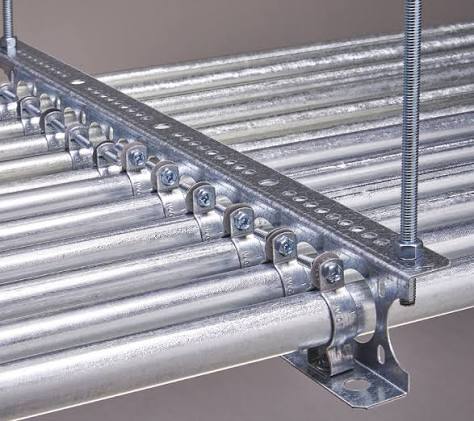
Engineered trapeze pipe supports provide advantages that extend well beyond supporting piping. By using a coordinated support system, contractors can reduce field fabrication, minimize installation variability, and improve coordination between mechanical, electrical, plumbing, and structural trades. Prefabricated trapeze assemblies arrive ready for installation, reducing time spent measuring, cutting, and assembling support systems on site. This approach helps maintain project schedules while producing more consistent installation quality throughout the facility. Standardized support layouts also simplify inspections because support locations and configurations follow approved engineering documentation. For large commercial and industrial projects, these efficiencies can contribute to lower labor costs and fewer installation conflicts.
Well-designed trapeze support systems also improve long-term building operation and maintenance. Organized pipe routing creates clear access to valves, equipment, and adjacent building systems, allowing maintenance personnel to perform inspections and repairs without unnecessary obstructions. Consistent spacing and properly supported piping reduce stress concentrations that could develop from unsupported spans or poorly distributed loads. Engineered support layouts also make future system modifications easier because additional piping or equipment can often be incorporated into an organized framing system with less disruption. This level of planning is especially valuable in hospitals, manufacturing facilities, laboratories, data centers, and other buildings where overhead mechanical systems are extensive. Selecting engineered trapeze pipe supports helps contractors deliver installations that are easier to construct, inspect, maintain, and expand throughout the life of the building.
Why Choose Strut Systems Installation?
Strut Systems Installation provides engineered trapeze pipe hanger solutions for commercial and industrial mechanical projects that demand accurate coordination, dependable installation, and long-term structural performance. Our team works closely with engineers, mechanical contractors, and project managers to design support systems that align with project specifications, building conditions, and applicable code requirements. From preliminary layout through final installation, SSI focuses on reducing field modifications by delivering coordinated support assemblies that integrate with surrounding MEP systems. Our experience with modular framing systems allows us to develop support solutions that accommodate complex piping layouts while maintaining accessibility for future maintenance and equipment servicing. Whether supporting a single mechanical room or an entire facility, our approach emphasizes planning, constructability, and installation efficiency. Early collaboration during project design helps identify potential coordination issues before construction begins.
In addition to installation services, SSI offers design-build support, BIM coordination, prefabrication, and complete modular framing solutions for projects of varying size and complexity. Prefabricated trapeze assemblies can reduce installation time, improve consistency across multiple support locations, and minimize on-site labor requirements. Our installation teams understand the importance of proper structural attachment methods, accurate hanger placement, and coordination with other building systems throughout every phase of construction. We work with project teams to develop support systems that meet engineering requirements while helping contractors maintain project schedules and installation quality. Whether your project involves healthcare facilities, manufacturing plants, commercial buildings, data centers, or institutional construction, SSI has the experience to deliver engineered trapeze pipe hanger systems that support reliable mechanical installations. Contact Strut Systems Installation early in your project planning process to discuss engineered pipe support solutions tailored to your facility and construction requirements.
Have a project and in need of guidance?
Let our experts assist you in making the right decision!


